
It All Started with Mathematics
When I was a little girl, I knew exactly where I was headed. Mathematics. Only mathematics. Nowhere else but mathematics. If anyone had asked me what I would do if I didn't get there, I probably would have asked them why I wouldn't.
The only problem was that I had to wait an entire summer for the next school year to begin. Out of boredom, I learned to knit. Once I discovered that I could change the shape of what I was knitting simply by adding a stitch in the right place, I was no longer bored.
The unicorn appeared while I was counting stitches. He slipped his muzzle beneath my knitting and asked where it led.
“Nowhere. It's just a pattern.”
“Then why does it branch?”
I showed him where I had knitted two stitches out of one and explained how it worked. He stared at the branching stitches as though I had just shown him two paths out of a forest.
At the time, it seemed like a good idea: if mathematics somehow slipped out of my reach, I could always teach knitting workshops, and perhaps even write a book about knitting. And so I had a Plan B, long before I had any reason to think I might need one.
These days, I sometimes feel like going back to that summer and asking my younger self, “What on earth did you need a Plan B for?” Sometimes I think that without it, I might have spent much longer searching for a way through where I had originally intended to go. Because although I knew how to turn one stitch into two, I had no idea what awaited me on the other path. The unicorn, as I later discovered, had decided to show me.
After I showed him how to knit two stitches out of one, the unicorn walked over to the table. On the open page, I had drawn several worlds, one on top of another. I had drawn the bottom one with a blunt pencil. For each of the others, I had sharpened it a little more.
“Which one is ours?” he asked.
I pointed to the one with the thickest lines.
Back in elementary school, I had had an out-of-body experience. Afterwards, I would spend hours sitting over my notebook, trying to put into words how I saw the world. I wanted to be a scientist. What interested me most were ideas and proofs. I imagined that one day I would systematize geometry, and that perhaps geometry itself might provide a way to solve some open problems in number theory.
“Why did you draw this one so roughly?” the unicorn asked.
“Because that's how I see it.”
The unicorn touched one of the finer lines with the tip of his horn.
“And here?”
“Here you can go deeper. Every level has its own limit. Ours is quite coarse compared with some of the others.”
“And are you going to draw them all?”
“Describe them mathematically,” I corrected him. “These are just sketches.”
I picked up my pencil and placed two dots on the paper. “Imagine that you can always put another point between them, no matter how close together they are. That's what a set that is ‘dense-in-itself’ looks like, the kind of set on which most mathematical structures are defined. Perhaps the universe as a whole could be described using such structures, but our physical world must have limits in order to exist at all. You can only go so deep into its structure, because otherwise light couldn't travel. It would never reach the next point. It's as if someone had deliberately set a limit on how deep you could go when creating our world. I want to develop mathematical structures that will allow me to describe precisely what I see.”
I turned the page. It was still blank. I remember how excited I was about everything I would one day write on it.
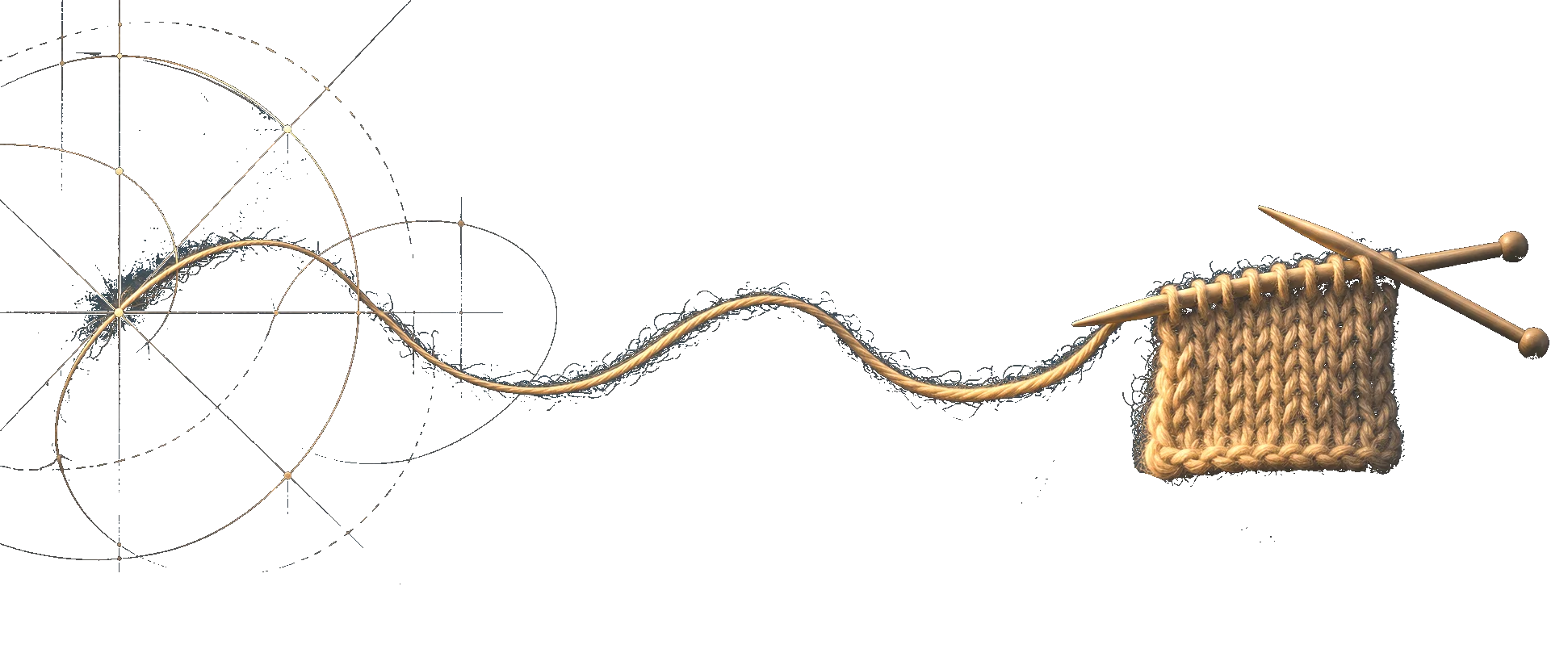
At first, he simply followed me. Whenever I sat down with my notebook, he would lie beside the table. Whenever I picked up my knitting needles, he would raise his head. One day, I caught him pulling yarn from a ball with the tip of his horn.
“What are you doing?”
“Seeing how long it is.”
“Well, unwind it.”
“That's what I'm doing.”
Only then did I notice that the yarn was running beneath the door. I opened it to pull the yarn back. On the other side, where the hallway should have been, a forest began.
“Give me back my hallway,” I said.
The unicorn pushed the door all the way open with his muzzle.
“I wanted to show you the world.”
“Well, go ahead. I'm looking.”
“I thought we might take a little walk.”
“How little?”
That was the first time he lowered his gaze.
Behind him, I saw a fork in the path. I recognized it immediately. One path split into two, just as one stitch had become two in my knitting. I could follow the left-hand path with my eyes all the way to its end. The right-hand path disappeared behind the first trees. I looked at the ball of yarn in my hand. The golden thread led to the right.
“That's my Plan B,” I said.
“I know,” said the unicorn. “I asked you where it led.”
Nowhere. It's just a pattern.
I was still holding the door handle. I could have closed the door, gone back to my notebook, and let him take his walk alone. Then the thread between my fingers tightened slightly, as though someone at the other end had given it a gentle tug.
“Just to see what's around the first bend,” I said.
The unicorn stepped aside to let me pass. It was only many years later that I realized he had never promised we would return the same way.
When I turned around after the bend, the door was no longer there among the trees. All I could see was the golden thread. I pulled it. It came back into my hand, broken.
“You said we were going for a little walk.”
“I did,” said the unicorn.
“Then you can at least help me wind this up.”
And so I carried on, with a ball of yarn that suddenly had two loose ends.
In real life, this is what it looked like: my plans for a career in science fell through, I never finished my education, and I had to start over from scratch several times, often without support. I worked on fixed-term contracts, and whenever one ended, I had to look for another job. For a long time, I still believed I would return to mathematics. Just this one more thing, I kept telling myself.
“And the knitting book?” the unicorn asked, holding the end of the yarn for me.
“I need a camera to make a book.”
“What do you have?”
Before I could answer, a familiar screech came from the treetops. I looked up. Sitting on the same branch were Đurica and Perica, my two parrots. Đurica leaned forward to get a better look at me, and Perica pushed her aside with her beak.
“All right,” I said. “I have a computer. The internet. And two parrots who clearly have something to say.”
The knitting book would have to wait.
And that was how Đurica and Perica got their own website. I learned HTML and CSS online and coded the entire site by hand. On their website, the parrots told stories from their own point of view. Among the people who noticed what I was doing was a man from Belišće whom I had never met in person. He introduced me to Mambo over Skype. The first time I opened the administration panel, it looked like an airplane cockpit.
I founded an association called Pravi red, hoping to bring people together and launch a knitting magazine. I built the website myself using Joomla 1.0. The association was featured in newspapers and on television. The magazine never came out.
While trying to get something of my own off the ground, I also wanted to understand how to run a business. I wanted to know what responsibilities I was taking on, what my obligations were, and what happened to the money. So I learned bookkeeping, and twenty-five years ago I became a self-employed bookkeeper.
“Was all of that part of Plan B?” the unicorn asked.
“Plan B was just knitting,” I said.
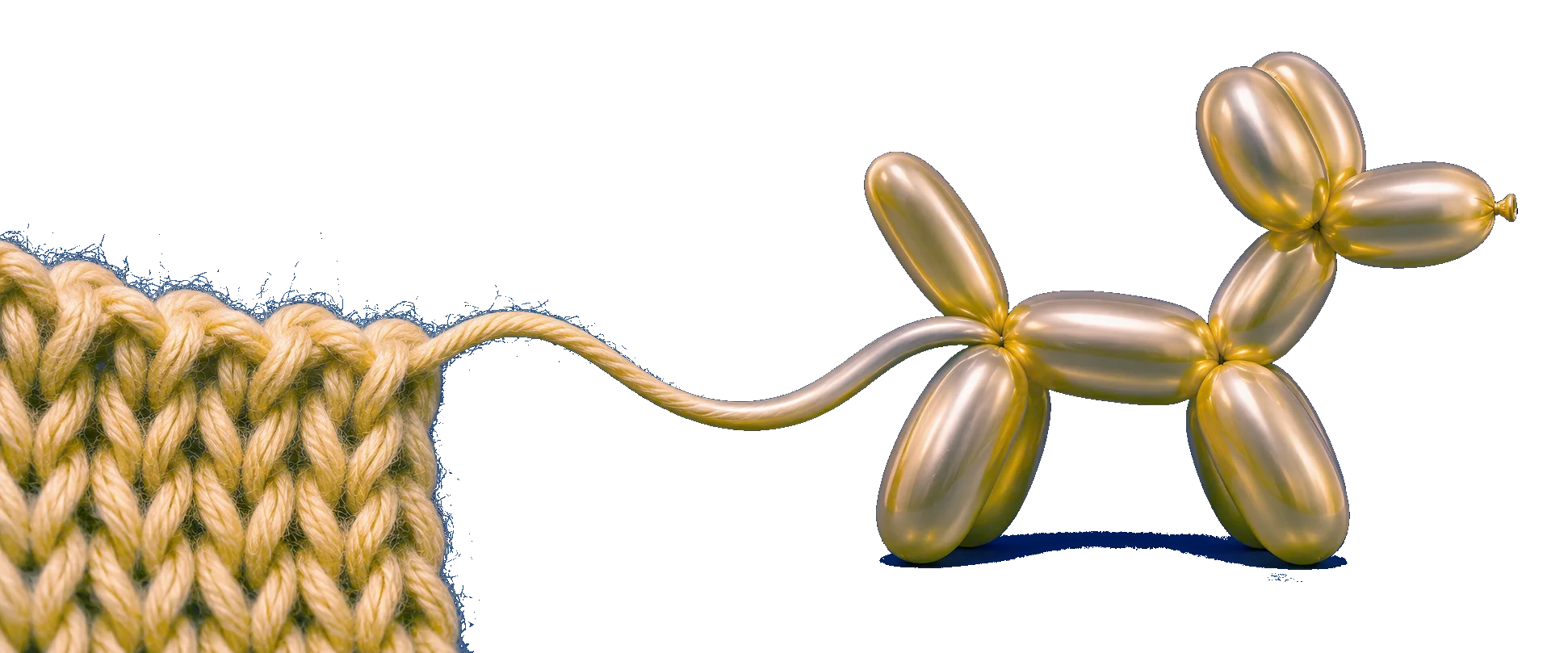
A little farther along, the path climbed between two rocks. I sat down on a flat stone to finish a row. When I reached for my ball of yarn, I found myself holding long balloons instead. There was a small pump in my pocket.
The unicorn waited until I had finished, then lowered his muzzle towards the dog I had just made.
“And this?”
“Still knitting. I've just changed the material.”
I immediately recognized the logic of knitting in balloon modelling. Here, too, there are patterns. The order of twists and knots determines whether you end up with a muzzle, a leg, or a tail. With my business, Fun Art, I tried to turn balloons into a livelihood. I had imagined it differently, but in the end, I was making balloon figures and selling them to children at stalls. I felt flattered when someone looked at what I had made and called me an artist. But in my head, I was always calculating how many twists it would take to achieve that particular shape.
On the hillside, I spotted a trail marker. The red circle was painted on a rock that had rolled down from the path.
“What does your trail marker tell you?” the unicorn asked.
“That the path used to be up there.”
I looked up. Where the rock had broken away, a narrow, well-trodden edge was still visible between the roots and the earth. A steep gully led up to it, so steep that I had to use both hands to climb. When I reached the top, for the first time I could see how far I had already come.
For years, I had seen every job as just one more bend in the road before returning to mathematics. And whenever I take something on, as soon as I understand how it works, I want to know how I can do it better. That is how web development and bookkeeping, which I had originally started learning for my own needs, gradually became services I provided to others.
When I founded MANIFOLD VERSA, I already had something to build on. Through JooWeb, I create websites. Through O.K., I personally manage my clients' books. And with balloons, I develop compositions that help brands stand out in the real world. When someone asks me what these three things have to do with one another, the answer seems simple to me: I wanted to do something creative, present it to people myself, and know how to run the business behind it.
The unicorn asked me once again where my pattern was leading. I remembered how, as a little girl, I had told him it led nowhere.
“I'm still knitting it,” I said. “Hold the end for me.”
This time, he held on.
Jasna Sontag